
Some plants are just pretty.
Indian borage is pretty and practical.
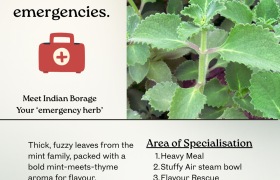
This thick, velvety herb sits quietly on a balcony or windowsill… until there’s a mini “emergency” at home:
- Heavy meal sitting like a stone in your stomach
- Stuffy air after a long, dusty commute
- Soup or sauce that somehow tastes flat, even after all that effort
- A room that smells a bit “closed” just before guests arrive
That’s when this bold, mint‑meets‑thyme leaf becomes the hero of the story.
In this guide, we’ll walk through five simple, everyday “emergency” uses of Indian borage you can try at home, using:
- Fresh leaves from your own Indian Borage Seedlings
- Pantry‑ready Dried Indian Borage Leaves
- Quick‑to‑use Indian Borage Infused Oil
Along the way, we’ll keep everything science‑aware, gentle and realistic—no miracle claims, just smart ways to use a very aromatic herb.
Meet Indian Borage (Mexican Mint / Cuban Oregano)
Indian borage (Plectranthus amboinicus) is a member of the mint family with thick, succulent leaves and a strong aroma that sits somewhere between mint, oregano and thyme. It’s also known in many places as Mexican mint, Cuban oregano, country borage or broad‑leaf thyme.
Researchers have found that the leaves are rich in essential oils (like thymol and carvacrol), flavonoids and other polyphenols with antimicrobial and anti‑inflammatory activity in laboratory and animal studies.
That doesn’t turn it into a medicine on its own—but it does help explain why so many cultures traditionally reach for this herb in teas, steams, rubs and home cooking.
Important: All ideas in this article are for everyday comfort, flavour and home care. They do not replace professional medical advice, diagnosis, treatment or emergency care.
1. A Quick “Comfort Cup” When the Air Feels Heavy
You know that feeling when the weather swings, dust is everywhere, and your chest or throat feels a bit “tight” and uncomfortable?
That’s one of the classic moments people reach for Indian borage tea.
How to brew a gentle Indian borage tea
You can use either dried or fresh leaves:
With dried leaves
- Add 1 teaspoon of Dried Indian Borage Leaves to 250 ml of freshly boiled water.
- Cover and leave to steep for 4–6 minutes.
- Strain, then sweeten lightly if you like (honey, date syrup or plain sugar).
- Sip slowly while warm.
With fresh leaves
- Rinse 2–3 medium leaves from your Indian Borage Seedlings.
- Tear gently to help release the oils.
- Brew as above, steeping for about 5 minutes before straining.
Why this cup makes sense
- Warm herbal drinks are a traditional way to bring comfort and moisture to the throat and chest.
- Lab studies on Plectranthus amboinicus show essential oil and extract components with antioxidant, antimicrobial and anti‑inflammatory activity, which may help explain why this herb is used historically for respiratory discomfort.
That doesn’t mean this tea “treats” any illness—but as a caffeine‑free comfort drink, it earns its place in the evening routine.
Safety first
- Keep portions moderate (1–2 cups a day as a food‑like drink for most healthy adults).
- If you’re pregnant, breastfeeding, have a health condition or take medication, talk to your health professional before drinking any herb regularly.
- For high fever, chest pain, difficulty breathing or symptoms that don’t improve, seek proper medical care quickly.
For more tea inspiration with mint family herbs, you can also check out our guide:
Brewing Bliss: A Guide to Mint Herbal Tea from Dried Leaves.
2. An Aromatic Steam Bowl for Stuffy, Stale Air
Sometimes the house feels heavy—maybe after harmattan dust, smoke from nearby cooking, or a long day with windows closed. A simple herbal steam bowl can feel like a mini spa for your nose and face.
How to make an Indian borage steam bowl
You’ll need:
- 1–2 teaspoons Dried Indian Borage Leaves
- Or a small handful of fresh leaves
- A heat‑proof bowl
- Hot (not violently boiling) water
- A towel
Steps
- Place the leaves into the bowl.
- Pour in enough hot water to half‑fill the bowl.
- Let it cool for 1–2 minutes so the steam is warm, not scalding.
- Sit comfortably, lean over the bowl at a safe distance and drape a towel loosely over your head.
- Breathe in the aromatic steam for 5–10 minutes, taking breaks if it feels too warm.
You’re simply using the strong, mint‑thyme aroma as a comfort ritual—similar to how people use menthol rubs or minty steams—without claiming to “treat” anything.
Very important safety notes
- Keep hot water far away from children and pets.
- This is not for babies or toddlers.
- Do not press your face too close to the water; steam burns are real.
- If you feel dizzy, too hot or uncomfortable, stop immediately.
3. A “Heavy Meal Helper” After Starchy or Oily Food
Big plates of swallow, rice, beans or rich sauces are comforting—but sometimes leave you feeling heavy or bloated.
Indian borage has a long history in traditional systems as a culinary herb used after heavy meals, especially in teas and spiced dishes.
Two simple ways to use Indian borage around meals
a) Light after‑meal sip
After a heavy or late dinner:
- Brew a small cup of Indian borage tea (as in Section 1).
- Sip slowly, instead of reaching straight for fizzy drinks.
The warm, aromatic drink encourages you to slow down, sit upright and give your stomach time to settle—simple lifestyle habits that make a practical difference on their own.
b) Add it directly into your cooking
Indian borage’s bold flavour stands up well in:
- Beans and stews
- Pepper soups
- Marinades for fish and meat
- Oily sauces that need more “lift”
Try:
- Crushing ½–1 teaspoon of Dried Indian Borage Leaves into the pot in the last 5–10 minutes of cooking, or
- Finishing dishes with a drizzle of Indian Borage Infused Oil as a flavour booster, just like you might use herb‑infused olive oil.
Start small—this herb is strong—and adjust to taste.
Again, this is about flavour and comfort, not treatment. If you often feel pain, burning, or severe discomfort after meals, get proper medical checks rather than self‑treating with herbs.
4. Emergency Flavour Rescue for “Flat” Pots
You’ve added onions, garlic, stock, pepper… yet the pot still tastes somehow flat. Before you give up, Indian borage can act like a tiny emergency reset for savoury dishes.
The leaf flavour is minty with a thyme‑like depth, thanks to aromatic compounds that give it a strong, herbal punch.
How to use Indian borage as a flavour fixer
For stews, beans and sauces
- Crush a pinch of Dried Indian Borage Leaves between your fingers.
- Stir into the pot in the last 3–5 minutes of cooking.
- Taste, then adjust salt or acid (a squeeze of lemon or lime) as needed.
For roasted or grilled foods
- After cooking, drizzle a little Indian Borage Infused Oil over:
- Roasted yams, potatoes or plantains
- Grilled fish or chicken
- Toasted bread or flatbreads
That last‑minute drizzle behaves like a finishing sauce, lifting the aroma right before serving.
If you enjoy this style of flavour “rescue”, you might also like our minty kitchen ideas in:
Elevate Your Lifestyle with Mint Ice Cubes—and Support a Greener Planet.
5. Living Air Freshener and Mood‑Lifting Balcony Buddy
Indian borage doesn’t only belong in the kitchen. With its thick leaves and strong scent, it makes a lovely living air freshener for small spaces.
Simple ways to use the plant around the home
- Balcony or window box:
Keep a pot of Indian Borage Seedlings near a window or balcony rail. When the breeze blows through the leaves, the scent gently circulates. - Hand “scent swipe”:
Before guests arrive, lightly rub a clean leaf between your fingers and brush your hands over curtain edges or around the balcony railing. The herb ensures a subtle, herbal scent without synthetic sprays. - Herbal corners:
Combine Indian borage with other aromatic plants like mint and marigold so your home garden does double duty: beautiful, fragrant and more attractive to helpful insects like pollinators.
For more ideas on using aromatic plants as natural helpers, you can read:
- Mints vs. Mosquitoes: Reclaim Your Bedroom and Sleep Peacefully
- Marigolds: The Golden Blossom with a Heart of Gold (and Benefits!)
Natural scent is powerful, but still just one layer. For proper pest and mosquito control, keep using nets, covered drains and other proven methods.
Growing Your Own “Emergency Herb” Kit
You don’t need a big backyard to enjoy Indian borage. A sunny balcony, corridor corner or bright kitchen window is enough.
Start with seedlings
Our Indian Borage Seedlings are:
- Raised with clean water and chemical‑free practices
- Grown and packed in Iperu Remo, Ogun State, with fast delivery to major cities
- Already strong enough to transplant into pots or beds
Basic care
- Light: Bright light with a few hours of sun daily.
- Water: Let the top of the soil dry slightly before watering again—this plant doesn’t like constantly soggy roots.
- Pruning: Regularly pinch off growing tips; it keeps the plant bushy and gives you fresh leaves to use.
Stock the pantry too
For days when rain is heavy, or you can’t step outside to cut fresh leaves, keep shelf‑stable options on hand:
- Dried Indian Borage Leaves – for teas, steams and cooking
- Indian Borage Infused Oil – for marinades, dressings and finishing drizzles
Together, the live plant plus pantry products give you a simple Indian Borage toolkit that covers flavour, comfort and home fragrance.
Frequently Asked Questions About Indian Borage
1. Is Indian borage the same as ordinary borage?
No.
- Indian borage is Plectranthus amboinicus, part of the mint family, with thick, fuzzy leaves and a strong, oregano‑like aroma.
- Common borage (Borago officinalis) is a different plant with blue star‑shaped flowers and a cucumber‑like taste, often used for its seed oil.
This article is about Plectranthus amboinicus, the one sold as Indian borage / Mexican mint / Cuban oregano in our shop.
2. Can I drink Indian borage tea every day?
Used like a culinary herb in small, food‑like amounts, Indian borage tea is generally considered safe for most healthy adults in traditional use.
However:
- There aren’t many long‑term human studies.
- If you’re pregnant, breastfeeding, managing a health condition, or taking regular medication, speak to a qualified health professional before using it daily.
- Stop immediately and seek help if you notice any unusual reactions.
3. Can children take Indian borage?
Many families traditionally give mild herbal teas to older children, but safety depends on age, health history and dose.
We recommend:
- Avoiding herbal teas in babies and toddlers unless specifically guided by a paediatric professional.
- For older children, use very weak tea, and only occasionally, after checking with a health practitioner who knows the child’s history.
4. I’m pregnant or breastfeeding. Is Indian borage safe for me?
Scientific data in pregnancy and lactation is limited. Some sources recommend caution with concentrated herbal use in these stages.
It’s best to:
- Treat Indian borage as a normal culinary herb only, in small quantities,
- Avoid heavy or long‑term self‑medication with any herb, and
- Ask your doctor or midwife before using Indian borage regularly as tea or steam.
5. How many leaves should I use in cooking?
For a family‑sized pot (4–6 servings):
- Start with ½–1 teaspoon dried leaves or 2–3 fresh leaves, chopped.
- Taste, then add a little more if you want a stronger flavour.
It’s easier to add more later than to fix an over‑herbed pot.
Ready to Give Indian Borage a Home?
If you’ve been curious about this bold little herb, now is a good time to add it to your home routine—gently, safely and deliciously.
Here’s how to get started:
- Grow your own with Indian Borage Seedlings for balcony or backyard.
- Keep a jar of Dried Indian Borage Leaves on the shelf for quick teas, steams and cooking.
- Add Indian Borage Infused Oil to your kitchen for last‑minute flavour rescue.
Browse more nature‑powered goodies on greenunison.com, or explore our full herb range via our WhatsApp catalogue:
👉 https://wa.me/c/2348103043789
Want personalised help choosing what to order?
Let Indian borage earn its spot as the “emergency herb” in your home—quietly waiting in its pot or jar, ready for those little moments when you need comfort, flavour or freshness in a hurry.
Leave a Reply