Category: Infused Oils

  • Clean Eating Upgrade: How to Switch Your Swallow to Plantain Flour Without Stress


    If you’ve been thinking, “I want to eat a bit cleaner, but I still want my swallow,” you’re not alone.

    Clean eating doesn’t have to mean salad every day or complicated rules. Sometimes, it’s as simple as choosing a swallow that comes from one familiar ingredient you can pronounce, cooked the same way you already love.

    That’s where plantain flour swallow comes in a simple, comforting plantain flour swallow upgrade that still feels like home.

    What Does “Clean” Mean Here?

    When we say “clean” in this context, we’re talking about:

    • Short ingredient lists
    • Familiar, minimally processed foods
    • Products you can explain in one sentence

    For swallow, that looks like:

    • A flour that is made from one main ingredient
    • No artificial colourants
    • No flavour enhancers
    • No unnecessary additives

    Plantain flour fits that picture beautifully when it’s made from carefully dried, milled unripe plantain.

    What Exactly Is Plantain Flour Swallow?

    Plantain flour swallow is made by cooking plantain flour with hot water until it becomes smooth, stretchy and moldable very similar to other swallows you already know, just with a different base.

    Good plantain flour is usually:

    • Made from peeled, dried, finely milled unripe plantains
    • Naturally free from artificial colourants
    • Neutral to slightly earthy in taste
    • Easy to pair with vegetable, fish, meat or mixed soups

    If you want a version that is already finely milled and ready for smooth swallow, you can look at:

    It’s designed for instant plantain amala-style swallow, with no sieving needed.

    Why People Call It a “Clean Eating Upgrade”

    1. Simple, clear ingredients

    When your swallow is made from just plantain flour and water, you know exactly what is on the plate. It fits nicely into a clean eating mindset where you can recognise and trust the ingredients.

    2. Familiar comfort, adjusted in a gentle way

    You still sit down with a warm plate of swallow and soup. You still tear, dip and enjoy. The routine is the same the main change is the flour you used.

    3. Easy to fit into normal life

    You don’t have to change your entire cooking style. Most of your soups stay the same. You’re just swapping the base you mould on the side.

    For many people, that’s a realistic way to “upgrade” without turning their whole kitchen upside down.

    How to Switch Your Swallow to Plantain Flour (Step by Step)

    If you’ve only ever eaten other types of swallow, trying something new can feel risky. Here’s a gentle way to start.

    Step 1: Start with a small quantity

    For the first trial:

    • Cook plantain flour for just one person, or
    • Make a mix of half plantain flour, half your usual swallow flour

    This way, the taste and texture are not a shock, and you can adjust gradually.

    Step 2: Learn the water–flour balance

    Plantain flour can behave slightly differently from other flours, so take note of:

    • How much water you boil
    • How much flour you sprinkle in
    • How long you stir on the heat

    A simple starting mini-guide (you can adjust to your preference):

    1. Bring water to a gentle boil.
    2. Reduce the heat slightly.
    3. Sprinkle in plantain flour gradually, stirring firmly with a wooden spoon.
    4. Keep mixing until it thickens and pulls away from the sides of the pot.
    5. If it’s too soft, sprinkle a little more flour. If it’s too thick, add a splash of hot water and mix in well.

    Using a finely milled option like

    Smooth Plantain Flour (Elubo Ogede)

    helps reduce lumps and makes the process quicker.

    Step 3: Pair it with soups you already love

    Don’t change everything at once. Use the same soups you normally enjoy:

    • Leafy vegetable soups
    • Pepper-based soups
    • Egusi-style soups
    • Light broths with fish or meat

    Keeping the soup familiar makes it easier to adjust to the new swallow texture.

    Step 4: Notice how it feels for you

    Pay attention to:

    • How satisfied you feel
    • How the texture feels in your mouth
    • How easy it is to finish your plate

    Everyone’s preferences are different. The goal isn’t perfection it’s finding what truly works for your own body and routine.

    Tips for Getting the Best Result with Plantain Flour Swallow

    • Use hot, not lukewarm water for cooking. It helps the flour bind properly.
    • Stir with confidence. Gentle, slow stirring can create more lumps. A firm, circular motion helps keep it smooth.
    • Cover and steam for a minute after cooking, then give it a final stir. This often improves the stretch and softness.
    • Serve it fresh. Like many swallows, plantain swallow is at its best soon after cooking.
    • Store the flour well. Keep it in an airtight container in a cool, dry cupboard, and always use a dry spoon.

    Where Plantain Flour Fits in Your Clean Eating Pantry

    Plantain flour works well alongside other simple, clean staples, for example:

    With just a few of these on your shelf, you can pull off:

    • Weeknight swallow and soup
    • Light weekend brunches
    • Pancakes or bakes using plantain flour as part of your flour mix
    • Quick thickening for certain dishes

    Gentle, Real-Life Clean Eating

    Clean eating doesn’t have to be dramatic. Sometimes, it’s just:

    • Reading the label
    • Choosing the simpler option
    • Stocking your pantry with things you actually cook with

    Switching from one type of swallow to plantain flour swallow is one of those quiet upgrades: your plate still looks familiar, but your ingredient list gets calmer and shorter.

    If you’ve been curious about plantain swallow, this might be your sign to try a small pot, taste it with your favourite soup, and see how your own body and schedule respond.

    Ready to Try the Plantain Flour Swallow Upgrade?

    When you’re ready to give it a proper test in your own kitchen, you can order directly:

    Prefer to chat first or order via message?

    Plantain flour swallow might not be the only way to enjoy a good meal, but it’s a beautiful option to have on the table especially if you’re gently moving towards cleaner, calmer, more intentional eating.

  • 60-Second Calm Skin Routine with Herbal Infused Oils

    60-Second Calm Skin Routine with Herbal Infused Oils

    Some days your face has seen it all — heat, dust, AC, traffic, screen time — and you only have a minute to breathe.

    This calm skin routine is designed for those days: one infused oil + one minute of gentle massage to help your skin feel softer and your mind feel a little more relaxed.

    No complicated steps. No harsh actives. Just simple, nature-powered care you can actually keep up with.


    Why a Short, Gentle Face Massage Helps You Feel Calm

    A few things we know from research and real-life experience:

    • Gentle facial massage can support local blood flow for a short time, which may help your skin look a bit more awake and refreshed after you’re done.
    • Massage is naturally relaxing for many people — the slow pressure and repeated strokes can feel like a mini “reset” after a long day.
    • Simple routines are easier to stick with. Current skincare trends are moving towards “skin minimalism”: fewer, more thoughtful steps, done consistently, instead of a long routine you abandon after a week.

    This routine is not a medical treatment and it doesn’t promise to fix any skin condition. It’s a cosmetic, feel-good ritual to help you enjoy your infused oils in a safe, gentle way.


    Infused Oil vs Essential Oil (and Why It Matters for Your Face)

    If you’ve ever searched for “oils for glowing skin” or “herbal oil for face”, you’ve probably seen two main types: essential oils and infused oils.

    Here’s the simple breakdown:

    • Essential oils
    • Highly concentrated plant aroma.
    • Usually need to be diluted in another oil before touching skin.
    • Can easily be too strong or irritating if used directly.
    • Infused oils
    • Herbs (like mint, marigold or lavender) are gently soaked in a carrier oil.
    • Result is a milder, ready-to-use cosmetic oil designed for direct topical use (with a patch test).
    • Great for everyday massage and moisturising.

    In this routine we’re focusing on herbal infused oils — the kind Green Unison makes — because they’re designed as cosmetic oils for skin and hair, external use only, with a softer feel that suits quick, daily rituals.

    Always read the label, keep them away from eyes and broken skin, and stop using if irritation shows up.


    Step-by-Step: Calm Skin Routine in 60 Seconds

    You can do this in front of a mirror, at your desk (with clean hands), or before bed after cleansing.

    If your face is very sweaty or dusty, wash it gently and pat dry first.

    Step 1: Choose Your Infused Oil (10 seconds)

    Pick one infused oil that matches how you feel right now:

    Or browse the full Infused Oils collection and pick the one that calls your name today.

    New to a particular herb? Do a patch test on the inner arm and wait 24 hours before using it on your face.


    Step 2: Prep Your Hands & Skin (10 seconds)

    1. Wash your hands or clean them with a wipe.
    2. Put 2–4 drops of your chosen infused oil into your palm.
    3. Rub your palms together to spread and warm the oil slightly.

    You’re aiming for a light glide, not a heavy oil layer.


    Step 3: 60-Second Gentle Massage Map

    You can use fingers only — no tools needed. Keep pressure soft to medium, never rough.

    0–15 seconds – Calm the jaw & cheeks

    • Place your fingers along your jawline.
    • Gently glide upwards towards your ears, then up to the cheekbones.
    • Repeat these slow strokes 3–4 times while breathing out deeply.

    15–30 seconds – Smooth the cheeks outward

    • Place both hands on the centre of your face (beside the nose).
    • Glide your fingers outward towards the temples.
    • Think slow, sweeping strokes — like you’re wiping away the day’s stress.

    30–45 seconds – Relax the forehead

    • Start at the centre of your forehead.
    • Glide your fingers outwards towards the temples in horizontal strokes.
    • Keep your shoulders relaxed; don’t clench your jaw.

    45–60 seconds – Finish with a “hug” for your skin

    • Use both hands to gently “press and release” your cheeks:
    • Lightly press palms to cheeks.
    • Hold for 2–3 seconds.
    • Release.
    • Repeat over your forehead and chin.

    If you have time, you can repeat the whole cycle once more. If not, you’ve still done a complete 60-second calm ritual.


    Everyday Skin, Everyday Life: When to Use This Routine

    You can fit this mini-ritual into different moments of your day:

    • Morning: After cleansing, before sunscreen — especially when the air feels dry or dusty.
    • Midday reset: After washing your face or using a gentle mist at work/home.
    • Night: After cleansing, as the last step before lights out.

    Most people will be fine doing this once a day. If your skin is already using other active products (acids, retinoids, etc.), keep this routine very simple and listen to your skin. If anything stings or feels wrong, stop and rinse off with a gentle cleanser.


    Which Green Unison Infused Oil Fits You Best?

    Here’s a quick guide to help you choose, based on mood and feel, not skin “type” labels:

    All infused oils are cosmetic products for external use only. Do not eat them, keep them away from eyes and broken skin, and discontinue use if irritation occurs.


    Safety First: Gentle, Science-Aware Self Care

    A few important reminders:

    • Patch test: Always patch test a new oil on a small area (like inner arm) and wait 24 hours.
    • Avoid sensitive areas: Keep oils away from eyes, lips, and broken or irritated skin.
    • Less is more: A few drops are enough. You don’t need to drench your face.
    • Health conditions: If you have ongoing skin issues or are under medical care, talk to a qualified health professional before adding new products or rituals.

    This routine is about comfort and care, not diagnosing, treating, or curing any condition.


    Shop the Routine & Chat with Us 💬

    Ready to try your own 60-second calm skin ritual?


    Keep Reading: More Herbal Skin Rituals You’ll Love

    If you enjoyed this calm skin routine, you might also like:

    ✨ Save this routine, share it with a friend, and let your one-minute calm ritual become a small, steady gift you give your skin every day.

  • Why Herbal Infused Oils Hit Different: A Nigerian Guide to Glowing Skin, Healthy Hair & Better Food

    No be juju, na science.

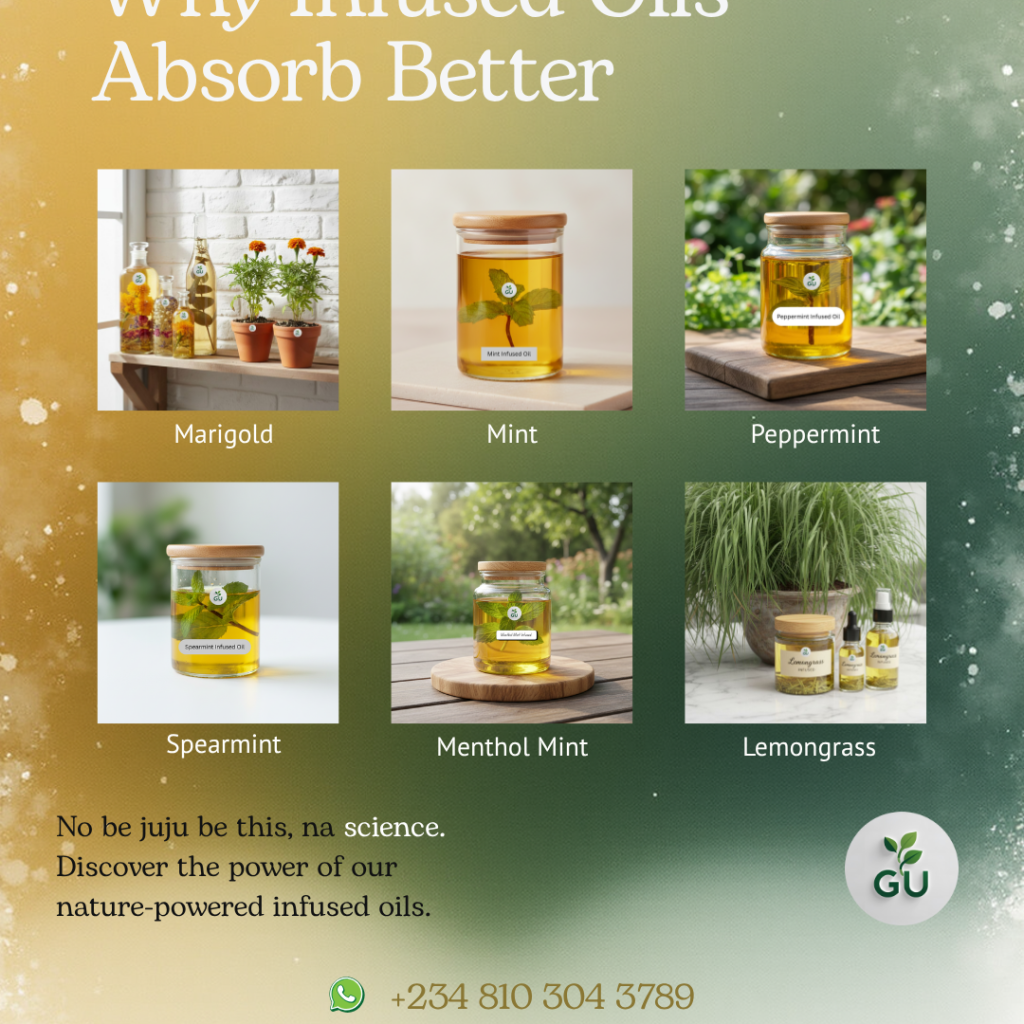
    Herbal infused oils are light, plant-powered oils that absorb fast and actually feed your skin and scalp—without the greasy feel. We make them by slowly steeping real herbs from our farm into nourishing oils.

    From our range, you can choose:

    🎥 Watch: what infused oils look like in real life
    https://youtube.com/shorts/E9Ni99bZvXA?si=QOPLkF_n0hdeRUCr


    What Are Herbal Infused Oils?

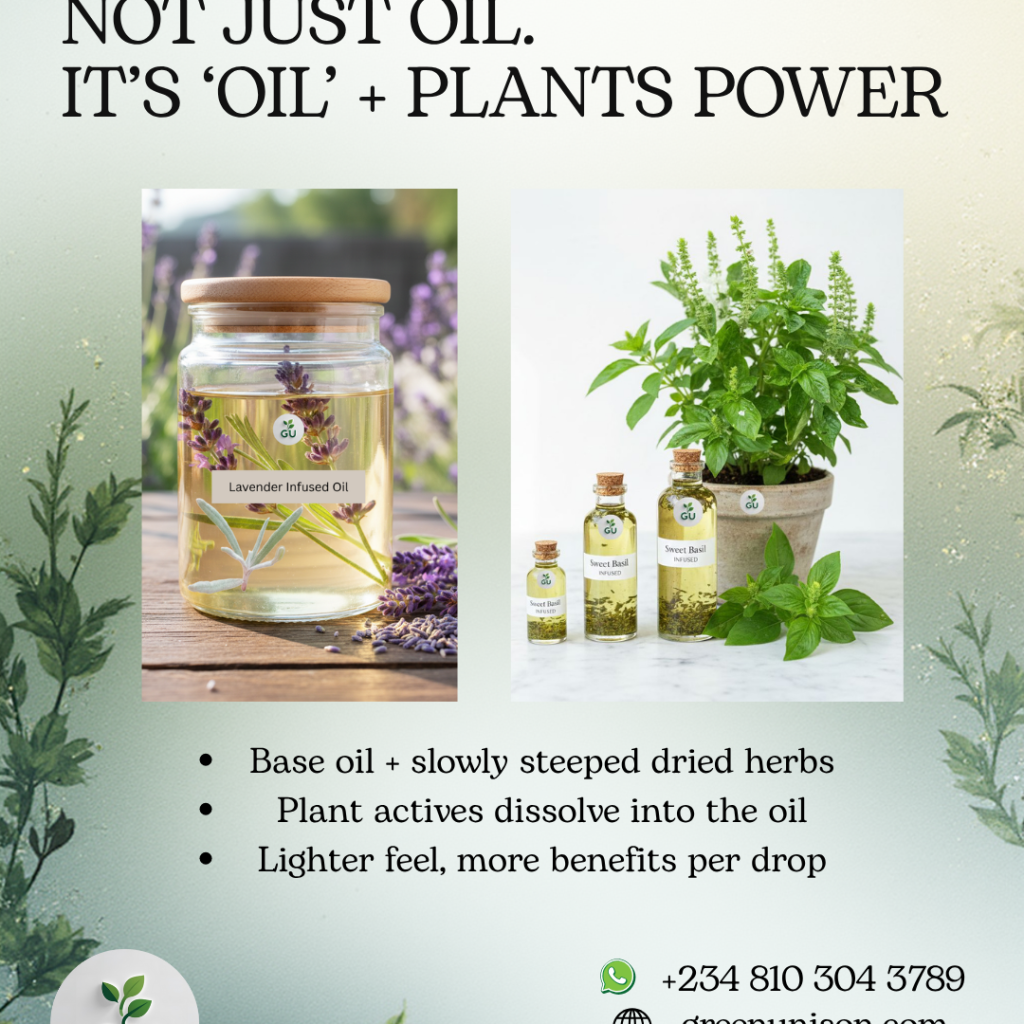
    Herbal infused oils are base oils (like sunflower or similar plant oils) that have been gently steeped with dried herbs over time. The plant’s soothing and protective compounds move into the oil, so every drop carries more than just “slip” and shine.

    They sit in a sweet spot:

    • Gentler than essential oils (no need to dilute again before normal use).
    • More functional than plain oils, because the herb brings its own benefits.

    Why They Absorb Better

    Compared to heavy oils and greasy pomades, a well-made infused oil:

    • Has a lighter texture, so it sinks in instead of sitting on top.
    • Carries plant actives in every drop from the infused herbs.
    • Lets your skin and scalp “drink” it in—benefit without the thick residue.

    That’s why people say it feels different from just “oiling” the skin or scalp.


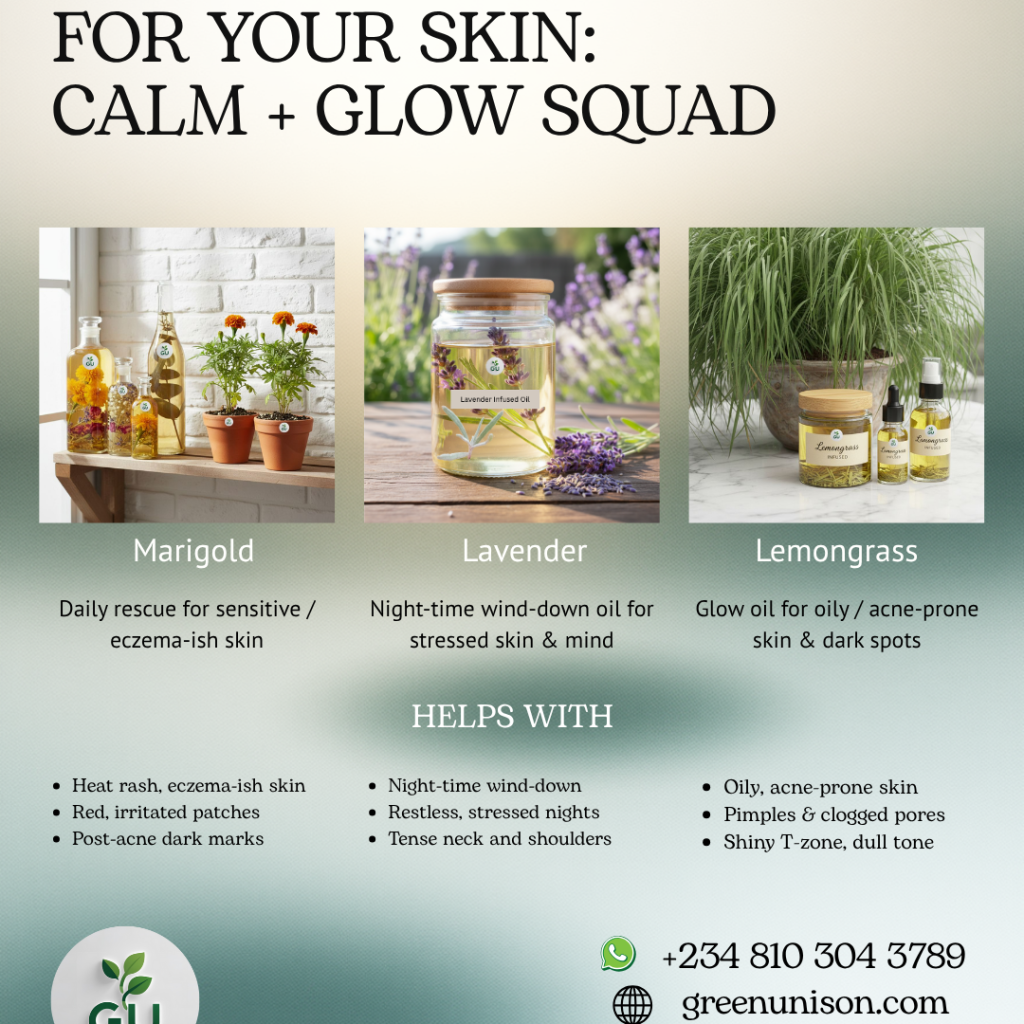
    For Your Skin: Calm + Glow Squad

    Your skin has different moods: sensitive, stressed, oily, dull. Think of our infused oils for skin as a small squad you can rotate instead of one “do it all” bottle.

    Marigold – daily rescue for sensitive / eczema-ish skin

    Marigold Infused Oil is that gentle friend your skin can trust.

    Great when you’re dealing with:

    • Heat rash or “eczema-ish” flare-ups
    • Red, irritated patches
    • Post-acne dark marks that need time and TLC

    Use a few drops on damp skin after your water-based products.


    Lavender moment – night-time wind-down for stressed skin & mind

    Lavender is all about evening wind-down. We pair it with a carrier so it’s skin-friendly.

    You can:

    • Add a tiny drop of Lavender Essential Oil into a spoon of your favourite infused oil (like marigold or lemongrass).
    • Use that mix as a night facial oil or neck/shoulder massage oil.

    It’s especially nice on nights when your skin feels tight and your mind is busy.


    Lemongrass – glow oil for oily / acne-prone skin & dark spots

    Lemongrass Infused Oil is your glow partner when you want light moisture, not heavy cream.

    Helpful when you notice:

    • Oily, acne-prone T-zone
    • Pimples and clogged pores that hate thick products
    • Shiny nose/forehead but dull overall tone
    • Dark spots that need a gentle, consistent routine

    Tap 2–3 drops into damp skin as the last step at night.


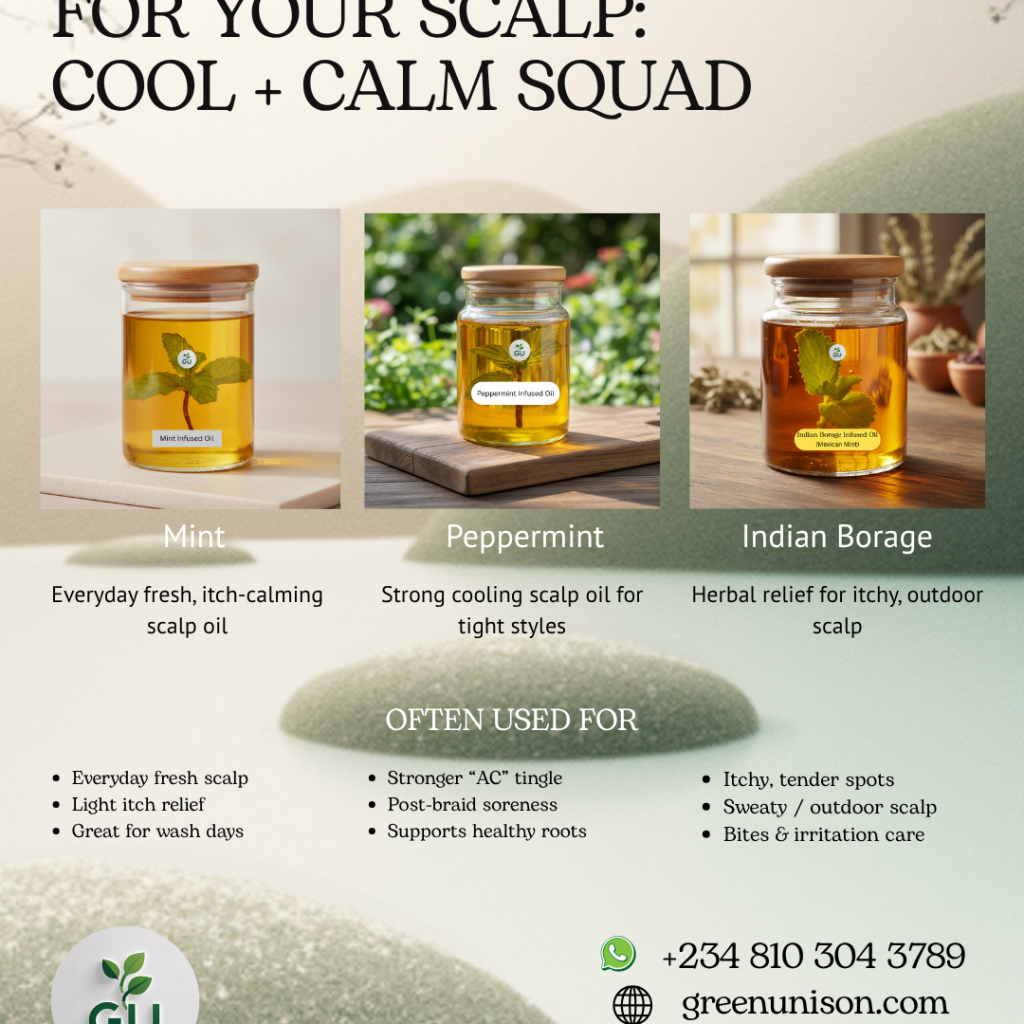
    For Your Scalp: Cool + Calm Squad

    Your scalp also has its own squad—cooling, itch-calming oils that work with braids, wigs, twists and silk presses.

    Herbal infused oils for the scalp can:

    • Help ease dryness and itch
    • Make tight styles feel more comfortable
    • Support your edges when you treat them gently

    Mint & co. – everyday fresh scalp care

    Choose based on how much “AC” you like:

    Simple routine

    1. Section your hair (or gently lift braids/wig).
    2. Put a few drops on your fingertips, not directly on your scalp.
    3. Massage in small circles for 3–5 minutes, 2–3 times a week.

    Pro tip: Oils work best on hair that isn’t bone-dry. Lightly mist with water first, then seal with a little oil.


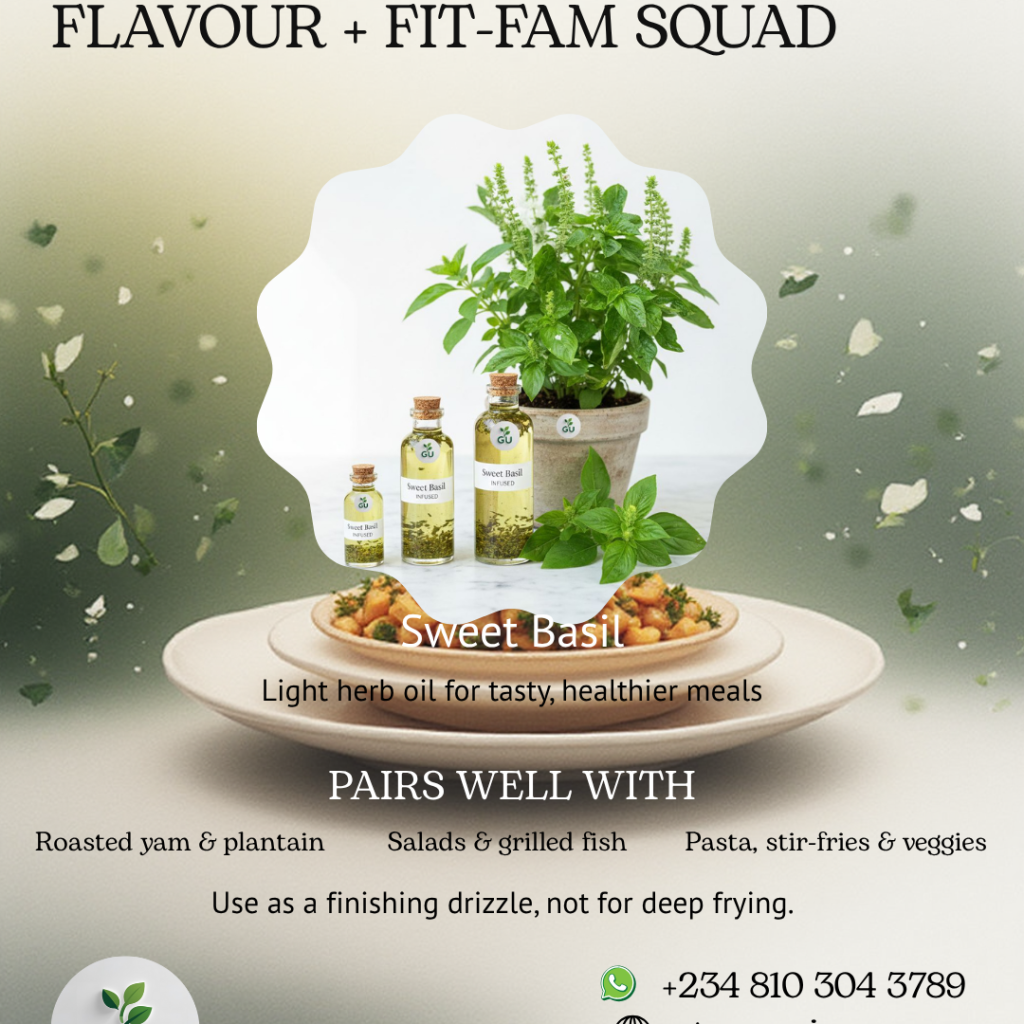
    For Your Food: Flavour + Fit-Fam Squad

    Infused oils aren’t only for your vanity—they belong in your kitchen too.

    Sweet Basil Infused Oil is made as a culinary finishing oil:

    • Drizzle over roasted yam and plantain
    • Pour over salads and grilled fish
    • Add to pasta, stir-fries and veggies just before serving

    Use it as a finishing touch, not for deep frying. You get flavour with a lighter feel.


    How We Make Them (Farm-to-Bottle)

    1. Grow & harvest herbs at the right time for flavour and potency.
    2. Gently dry them to lock in goodness and prevent moisture problems.
    3. Slow-infuse the herbs into a suitable base oil for several weeks.
    4. Strain, rest and bottle in small batches so everything stays fresh.

    No shortcuts, no magic tricks. Just patience and plants.


    How to Choose & Use (Real-Life Routines)

    A few ideas to get you started:

    • AM/PM face oil: 2–3 drops of marigold or lemongrass on damp skin after your water-based routine.
    • Scalp comfort: a few drops of mint-family oils massaged in 2–3 times a week.
    • Pre-shampoo treatment: oil your scalp and lengths 20–30 minutes before shampoo.
    • Kitchen: a splash of sweet basil oil over cooked food to make simple meals feel special.

    You don’t need all of them at once. Start with the one that matches your biggest need—calm skin, cool scalp or flavourful food—and build from there.


    Real-Life FAQs About Infused Oils

    1. Are infused oils and essential oils the same thing?

    No. Essential oils are highly concentrated plant extracts. You always have to dilute them before putting them on your skin.

    Infused oils are gentler: the herb is steeped in a base oil, so you get a softer, ready-to-use product for everyday skin and scalp care.

    You can layer them: for example, add a tiny drop of Lavender Essential Oil into a spoon of infused oil if you want extra scent at night.


    2. Will infused oils make me greasy?

    They shouldn’t—if you use small amounts.

    • On skin: 2–3 drops on damp skin is usually enough.
    • On scalp: focus on fingertips and massage in; don’t pour directly from the bottle onto your head.
    • On food: use as a finishing drizzle, not a deep-fry oil.

    If you feel greasy, you probably need less product, not a different oil.


    3. Can I use infused oils on my face?

    Yes, many people do.

    Always patch-test on a small area first and keep using your sunscreen in the daytime.


    4. Can I use infused oils under braids, wigs or silk presses?

    Yes—just be gentle.

    • Use drops, not squeezes.
    • Focus on parts and edges.
    • Keep a regular wash routine so there’s no heavy buildup.
    • Choose lighter options like Lemongrass Infused Oil if your hair gets weighed down easily.

    5. How long do infused oils last?

    Kept in a cool, dry place away from direct sunlight, most infused oils are best used within 6–12 months.

    • Close the bottle tightly after use.
    • Don’t dip wet fingers into the oil.
    • If it ever smells “off” or looks cloudy in a strange way, it’s time to let it go.

    Ready to Experience the Difference?

    Herbal infused oils are more than “just” oil. They’re a simple, daily way to:

    • Feed your skin and scalp with real plant goodness
    • Make your self-care feel more intentional
    • Turn everyday meals into something special

    Your glow, your roots, your plate – all nourished, naturally.


    Start Your Herbal Oil Ritual

    ✨ Not sure where to begin? Start with one infused oil and a simple daily routine.

    🛍️ Shop herbal infused oils on our website

    🛒 Order via our WhatsApp catalog

    💬 Prefer to chat first? Send us a WhatsApp message and we’ll help you choose the right blend for your skin, scalp and lifestyle.

  • Peppermint vs Marigold: Choosing the Right Infused Oil for Skin, Hair and Kitchen Routines


    There are days when your body is quietly asking for small rituals a cooling scalp massage after taking your wig off, a soft body oil after shower, or a simple drizzle of flavour over food that is already in the pot.

    Herbal infused oils are one of the easiest ways to add those rituals into real life. But once you see different bottles on the shelf peppermint, marigold, basil, Indian borage the big question appears:

    Which one should I actually be using?

    In this guide, we will gently compare peppermint-family infused oils with marigold infused oil, show where culinary infused oils come in for cooking, and help you choose the right bottle for your own skin, hair and kitchen routines.

    First Things First: Not Every Oil Is for the Same Job

    Before we compare peppermint and marigold, it helps to clear up three quick points:

    1. Infused oils are different from essential oils. Essential oils are highly concentrated and must be diluted before use. Infused oils are herbs slowly steeped in a carrier oil, so they are already in a gentler form that feels more like a normal body oil.
    2. Some infused oils are cosmetic only. Oils like Peppermint Infused Oil – Invigorating & Cooling, Mint Infused Oil – Cooling & Herbal, Spearmint Infused Oil – Sweet & Refreshing and Marigold Infused Oil – Soft & Comforting are clearly labelled as cosmetic oils for external use only. They are made for skin, scalp and massage not for eating.
    3. Some infused oils are made for food. Culinary oils like Sweet Basil Infused Oil – Warm & Herbal (Culinary) and Indian Borage Infused Oil – Bold & Aromatic (Culinary) are created specifically for cooking and finishing food. These are the ones you drizzle over roasted yam, stews or grilled fish.

    So while your content calendar says “Peppermint Oil, Marigold Oil”, in real life we are talking about peppermint-family infused oils for external use and marigold infused oil for external use, plus a few separate culinary oils for the kitchen.

    Peppermint-Family Infused Oils: Fresh, Cooling, Wake-Up Energy

    If you like that “mini AC on your skin” feeling, peppermint and the wider mint family will feel familiar very quickly.

    Green Unison offers a small mint line so you can choose the intensity that suits you:

    All of these are cosmetic oils for skin, hair and massage. They are not edible.

    What does peppermint infused oil feel like?

    When you apply a mint-infused oil, one of the main plant compounds, menthol, interacts with “cold” receptors on your skin. Your brain reads that as a cooling sensation, even though the actual temperature has not really dropped. The result is a fresh, wake-up feel rather than heat.

    Because the mint leaves have been gently steeped into a base oil, you get:

    • A light to medium texture that spreads easily.
    • A refreshing herbal aroma instead of a flat oil smell.
    • A cooling sensation that can feel especially nice on the scalp, neck, shoulders, feet and tired legs.

    Simple ways to use peppermint-family infused oils

    You can build tiny, realistic rituals into your day with just a few drops:

    • Scalp massage oil: Apply a small amount of Peppermint Infused Oil or Menthol Mint Infused Oil to your fingertips and massage gently into the scalp, avoiding the eye area. Patch test first.
    • Post-workout or “I’m tired” legs and feet: Massage a little Mint Infused Oil into clean legs and feet for that cool, refreshed feel.
    • Everyday “fresh” body oil: If you want a softer mint, Spearmint Infused Oil gives a gentler cooling effect and sweet mint aroma.

    Safety note: These are cosmetic oils for external use only. Always patch test on a small area first and avoid the eye area or broken skin. If irritation occurs, stop using immediately.

    Marigold Infused Oil: Soft, Comforting, Everyday Calm

    Where peppermint feels like “wake up”, marigold feels like “exhale”.

    Marigold Infused Oil – Soft & Comforting is made by slowly infusing dried marigold petals into a gentle carrier oil. The result is a cosmetic oil with a light floral scent and a smooth, nourishing glide.

    What does marigold infused oil feel like?

    Instead of a strong cooling sensation, marigold oil is about softness and comfort:

    • Texture is usually smooth and easy to spread across damp or dry skin.
    • The floral aroma is light, not overpowering.
    • The overall feel is “quiet” and cosy – perfect for slow evenings.

    Simple ways to use marigold infused oil

    • After-shower body oil: Apply a small amount of Marigold Infused Oil on damp skin after your bath or shower for a smooth, comfortable glide.
    • Hand and foot oil: Massage into hands and feet before bed as a soft, soothing step between your day and your sleep.
    • Layering under or over lotion: Use a few drops under a simple lotion, or add a little oil on top to increase slip and comfort.

    Safety note: Again, this is a cosmetic oil for external use only and not for eating. Patch test first and discontinue use if irritation occurs.

    Peppermint vs Marigold: Which Infused Oil Matches Your Mood?

    Here is a quick side-by-side view to help you decide between peppermint-family infused oils and marigold infused oil:

    Feature Peppermint / Mint Infused Oils Marigold Infused Oil
    Overall mood Fresh, cooling, “wake me up” Soft, comforting, “help me unwind”
    Typical feel on skin Cooling sensation on skin and scalp Smooth glide with gentle floral feel
    Best everyday uses Scalp massage, tired legs/feet, “fresh” body oil After-shower body oil, hand and foot massage, slow evening care
    Aroma Herbal mint; can be strong or mild depending on the bottle Light, soft floral
    Use on food? No. For external cosmetic use only. No. For external cosmetic use only.
    Good starting point if you love… That cool, minty feel on your scalp and body Gentle, quiet body oils without strong scents

    Where Does Cooking Come In? The Role of Culinary Infused Oils

    The “kitchen” part of your oil routine belongs mainly to culinary infused oils like basil and Indian borage, not cosmetic peppermint or marigold oils.

    For food, Green Unison offers options such as:

    These oils are clearly labelled for food use. You can:

    • Drizzle them over finished dishes as a last-minute flavour boost.
    • Stir them into marinades, dressings and dips.
    • Add a little over roasted yam, potatoes or vegetables just before serving.

    Important: Cosmetic infused oils (peppermint, marigold, lavender, spearmint, menthol mint and similar bottles) are not edible. Always follow the label and use culinary oils for food, cosmetic oils for skin and hair.

    Which Infused Oil Should You Start With?

    If you are just building your infused oil collection, here are some simple starting points:

    If you want a bigger overview of what herbal infused oils can do in general, you can also read our earlier guide on the blog about how herbal infused oils “hit different” and support everyday routines.

    How to Use Infused Oils Safely in Your Routine

    To keep things safe and comfortable, build these habits into your routine:

    • Check the label: Confirm if the oil is for cosmetic use or food use before you do anything else.
    • Patch test first: Apply a small amount of cosmetic oil to a small area and wait 24 hours to see how your skin responds.
    • Avoid sensitive areas: Do not apply peppermint-family oils near the eyes or on broken skin. Wash hands after use.
    • Use a little at a time: Infused oils are designed to spread well. Start with a few drops and add more only if needed.
    • Store properly: Keep bottles tightly closed in a cool, dry place away from direct sunlight.

    Where to Buy Peppermint, Marigold and Culinary Infused Oils

    You can order infused oils directly from the Green Unison shop:

    If you prefer to shop or ask questions via chat:

    You do not need twenty different products to create soft, grounding rituals at home. A few carefully chosen infused oils can go a long way whether you are pouring them into your palm for a scalp massage, smoothing them over damp skin, or drizzling a culinary oil over food that is already on the table.

    Start with the bottle that matches your current mood  peppermint for fresh energy, marigold for quiet softness, basil or Indian borage for flavour and let your routine grow from there.

  • Soft Evenings with Marigold: Petals, Hydrosols and Gentle Rituals

    There are some evenings that don’t need loud music or complicated routines. The fan is humming, the weather is finally cooling down, and your body is just asking for something soft a quiet drink, a gentle mist on your face, a light floral scent on your pillow.

    Those are marigold evenings.

    In this guide, we’ll explore simple ways to use dried marigold petals and marigold hydrosols to create soft night-time rituals you can actually keep up with no drama, no pressure, just small moments that feel good after a long day.

    Why Marigold Fits So Well into Soft Evenings

    Marigold is one of those flowers that looks bright and cheerful on the farm, but also knows how to calm everything down when the sun goes down.

    At Green Unison, marigold shows up in different forms, including:

    Both of these are versatile and easy to weave into simple rituals. One works more like a dry ingredient (for tea, bath blends and DIY infusions), the other behaves like a fine mist (for face, body, linens and room air).

    Meet Your Evening Partners: Marigold Petals and Hydrosols

    Dried marigold petals: colour, aroma and calm energy

    Dried Marigold Petals are simply marigold flowers that have been gently dried to preserve their golden colour and soft aroma. They are perfect for:

    • Caffeine-free herbal teas and blends.
    • Warm bath soaks and foot soaks.
    • Simple DIY oil infusions for external use.
    • Decorating candles, soaps and self-care gifts.

    The petals release their character slowly when they meet hot water or warm oil, which makes them ideal for unhurried evening rituals.

    Marigold hydrosol: a gentle floral water for misting

    Marigold Hydrosol – Gentle & Soothing is a floral water created during steam distillation of marigold plants. As steam passes through the flowers, it carries tiny amounts of oil-loving compounds and floral aroma. When that steam cools and condenses, the water phase collected is called a hydrosol.

    The result is a light, water-based liquid that can be used as:

    • A gentle face mist or toner.
    • A cooling body mist on warm evenings.
    • A linen and pillow spray for soft floral scent.
    • A quick room mist for calming the space before bed.

    Because hydrosols are water-based and much lighter than pure essential oils, they tend to feel gentle and easy to use in daily life.

    Soft Evening Ritual 1: A Golden Marigold Tea Moment

    A warm, caffeine-free drink can act like a soft “switch” between the noise of the day and the quiet of the evening. Marigold petals fit beautifully into that moment.

    How to prepare a simple marigold-based tea blend

    You can use Dried Marigold Petals alone or mix them with other gentle herbs like dried lemongrass or mint from the Dried Herbs Collection.

    1. Add 1–2 teaspoons of dried marigold petals (alone or in a blend) to a clean mug or teapot.
    2. Pour freshly boiled water over the petals.
    3. Cover and allow to steep for about 5–10 minutes, depending on how strong you like it.
    4. Strain into another mug and sip slowly.

    The colour is a soft golden-yellow, and the taste is gentle and mild. You can enjoy it plain or add a little honey if that matches your routine.

    Note: Herbal teas are not a replacement for medical treatment. If you are pregnant, breastfeeding or on medication, talk to a qualified health professional before adding new herbal drinks to your routine.

    Soft Evening Ritual 2: Marigold Bath or Foot Soak

    Not every evening allows for a full bath, but even a simple foot soak can make your body feel like, “Okay, we are done for today.” Marigold petals turn that into a small golden ceremony.

    How to create a marigold soak

    1. Fill a basin (for feet) or bathtub (for a full soak) with comfortably warm water.
    2. Add a small handful of Dried Marigold Petals. You can also pair them with a little dried lemongrass or lavender for aroma.
    3. Allow the petals to sit in the water for a few minutes so they can release colour and scent.
    4. Soak your feet or relax in the bath for 10–20 minutes, breathing normally and letting your shoulders drop.

    This is not about scrubbing or doing any intense treatment. It’s just about giving your body a warm, gentle signal that the day is winding down.

    Soft Evening Ritual 3: Face and Body Mists with Marigold Hydrosol

    On warm evenings, anything heavy on the skin can feel like too much. This is where a light hydrosol mist shines.

    Marigold Hydrosol – Gentle & Soothing works well as a quick refresh during your night routine.

    Simple ways to use marigold hydrosol at night

    • Face mist after cleansing: After washing your face, close your eyes and spray a fine mist of marigold hydrosol over your skin. Let it sit for a few seconds, then follow with your usual moisturiser or facial oil.
    • Light body mist: On very warm nights, use the hydrosol as a quick spray over arms, chest and shoulders instead of or before heavier products.
    • Pillow and linen spray: Spritz lightly over your pillowcases and bedding a few minutes before lying down for a soft floral scent.
    • Room mist: Give the air in your bedroom a few sprays while you’re doing other tasks like folding clothes or setting out your clothes for the next day.

    Because hydrosols are water-based, they usually dry quickly on skin and fabrics, leaving behind a gentle scent rather than a long-lasting perfume.

    Soft Evening Ritual 4: Layering Hydrosol with Marigold Infused Oil

    If you already have Marigold Infused Oil – Soft & Comforting in your collection, you can pair it with marigold hydrosol for a simple two-step routine on nights when your skin feels dry or rough.

    Two-step marigold body ritual

    1. After showering, mist your skin with Marigold Hydrosol while it is still slightly damp.
    2. Apply a small amount of Marigold Infused Oil over the damp skin, massaging gently until it absorbs.

    The hydrosol adds a first layer of light moisture and floral water, while the oil adds slip and comfort on top. Together, they create an evening routine that feels soft but not heavy.

    How to Build Your Own “Soft Evening” Shelf with Marigold

    You don’t need a full spa cabinet to enjoy marigold. A few carefully chosen items can cover many small rituals:

    With just these pieces, you can create a rotation of marigold-based habits: tea on some nights, body mists on others, a bath soak when you have more time, and a quick pillow spray on very busy days.

    Where to Order Marigold Petals and Hydrosols

    You can order everything you need for soft marigold evenings directly from the Green Unison shop:

    If you’d rather ask questions or place your order via chat:

    Soft evenings do not require a perfect life or an expensive spa. Sometimes they are just made of small choices: boiling water for a simple marigold tea, misting your face with a floral water, or taking two minutes to spray your pillow before you lie down.

    However your days are going right now, you can give yourself one tiny marigold ritual tonight and let your body know: “We are slowing down now. It is safe to rest.”

    This article shares general lifestyle information only. It does not make medical or dermatological claims and is not a substitute for professional advice.

  • From Scalp to Strands: How Herbal Oils Support Stronger Hair Roots

    Most of the time when we talk about “healthy hair”, we rush straight to products for the strands themselves leave-ins, stylers, gels, mousses. But if you’ve ever watched shed hairs collect in the sink or struggled with tension from tight styles, you already know the truth:

    Real hair care starts at the scalp.

    In this guide, we’ll talk about how peppermint and other herbal oils can support routines that help your hair feel stronger from the roots up. No magic promises just simple, realistic ways to use infused oils and essential oils in a way that respects your scalp, your strands and your lifestyle.

    Stronger Hair Roots Starts with Scalp Care

    Your hair strands don’t grow in thin air. Each one starts inside a tiny structure under your scalp called a hair follicle. How you treat your scalp, day after day, influences how your hair behaves from root to tip.

    A scalp-friendly routine usually includes:

    • Regular but gentle cleansing (not stripping your scalp completely dry).
    • Not overloading the roots with thick products that never rinse out.
    • Avoiding constant tension from very tight styles or heavy extensions.
    • Using oils mainly to add slip, comfort and protection  not to “fix” everything.

    Herbal oils come in here as helpers, not heroes. They make it easier to massage the scalp, reduce friction when you undo braids, and coat strands so they move against each other more easily. All of that can help your hair feel stronger and less stressed over time.

    Herbal Oils 101: Infused Oils vs Essential Oils

    Before we talk about specific products, it helps to understand two main oil families:

    Infused oils – gentle, ready-to-use blends

    Infused oils are made by steeping whole herbs in a base oil for a period of time. The herb slowly releases oil-loving compounds and aroma into the carrier oil, giving you a product that feels like a normal oil but carries the character of the plant.

    Examples from the Green Unison range include:

    These are cosmetic oils for external use – perfect for scalp massages, hair oiling and body care.

    Essential oils – concentrated drops

    Essential oils are highly concentrated plant extracts, usually obtained through steam distillation. They are very strong and must always be diluted in a carrier oil before touching your skin or scalp.

    For example:

    A little goes a long way. They are great for adding scent and a cooling feel to a blend, but they are not used neat on the scalp.

    What Peppermint Brings to a Scalp Routine

    Peppermint is almost always in the conversation when people talk about stronger-feeling hair roots. There are two main reasons:

    • It has a fresh, cooling sensation that makes scalp massages feel more awakened and alive.
    • It carries a clean, “open” aroma that many people associate with a refreshed, reset scalp.

    When menthol in peppermint meets your skin, it interacts with “cold” receptors, so your brain reads the feeling as cool and refreshing. That sensation can make a basic scalp massage feel like a proper treatment even if all you did was take a few minutes for yourself.

    Peppermint-infused vs peppermint essential oil

    You can bring peppermint into your routine in two main ways:

    • Using a mint-based infused oil straight from the bottle – like Mint Infused Oil, Spearmint Infused Oil or Menthol Mint Infused Oil. These are already blended with a carrier oil and ready to use on skin and scalp (external only).
    • Adding one or two drops of peppermint essential oil into a larger pool of carrier oil – for example, blending a drop into a spoon of your favourite infused oil in your palm before massaging it in. Always keep the essential oil percentage very low.

    Either way, the star of the show is the scalp massage itself. The peppermint simply helps that moment feel fresher, cooler and more intentional.

    Other Herbal Oils That Support Hair Roots and Strands

    Peppermint is the loud, minty one in the room, but it is not the only herb that supports calm, consistent hair care.

    Marigold infused oil – soft comfort for scalp and ends

    Marigold Infused Oil – Soft & Comforting has a gentle floral character and smooth glide. It is especially nice when:

    • Your scalp feels a bit tired after tight styles and you’re taking a break.
    • Your ends feel rough or dry and need extra slip before you sleep.
    • You want a body oil that can also be rubbed lightly over the hairline and nape.

    Lavender infused oil – calm evenings for you and your hair

    Lavender Infused Oil – Calm & Soothing brings a soft, relaxing scent to night-time routines. It pairs well with gentle protective styles and “no stress” evenings when you are carefully detangling or oiling your scalp before bed.

    Together, these herbal oils help you create a full routine: peppermint-family oils for “wake up” and energy, marigold and lavender for “slow down” and comfort.

    Simple Scalp Rituals for Stronger-Feeling Hair Roots

    Let’s turn all this theory into small steps you can actually keep up with. Here are a few realistic scalp rituals using herbal oils:

    1. Pre-shampoo scalp massage

    1. Before washing your hair, part it into sections.
    2. Place a little Mint Infused Oil – Cooling & Herbal or Spearmint Infused Oil – Sweet & Refreshing on your fingertips (not directly on your scalp).
    3. Massage gently into the scalp with small circular motions for 5–10 minutes, focusing on tense areas like the crown and nape.
    4. Follow with your usual shampoo and conditioner.

    This helps loosen product build-up, adds slip so your fingers move comfortably and turns wash day into a more soothing ritual.

    2. Post-braid or wig-takedown “reset”

    1. After taking down braids or removing a wig, gently finger-detangle and remove shed hairs.
    2. Lightly mist your scalp and hair with water or a gentle hydrosol.
    3. Apply a small amount of Marigold Infused Oil or a blend of marigold with a few drops of peppermint-infused oil to your fingertips.
    4. Massage into the scalp and smooth a bit down the strands, especially on areas that experienced tension.

    The goal here is not to overload your hair with oil, but to give your scalp comfort and your strands extra slip while you rest between styles.

    3. Night-time hairline and nape care

    1. Before bed, mist your hairline and nape lightly with water.
    2. Add a small drop of Lavender Infused Oil or a lavender-marigold mix to your fingertips.
    3. Gently massage around the edges, nape and any areas that rub against scarves, caps or pillowcases.
    4. Wrap or cover your hair as usual.

    These tiny routines, repeated week after week, support hair that feels more resilient, less dry and less stressed from styling.

    From Scalp to Strands: Using Herbal Oils Along the Hair Length

    Once the scalp is cared for, you can use herbal oils to support the rest of the strand without making it stiff or greasy.

    Light oiling on damp hair

    After washing or misting your hair:

    • Apply your leave-in or moisturiser first.
    • Then smooth a small amount of Marigold Infused Oil or a mint-infused oil blend over the mid-lengths and ends.
    • Focus on areas that rub on clothes, caps or headrests.

    This helps reduce friction between strands, so they move past each other more easily instead of catching and snagging.

    Finishing touch after styling

    Once you have finished braiding, twisting or packing your hair:

    • Rub a drop or two of oil between your palms.
    • Lightly smooth over the surface of the style and ends.
    • Avoid drenching the roots – the aim is shine and slip, not heaviness.

    Again, the goal is to create an environment where your hair feels protected, instead of constantly pulled and rubbed dry.

    How to Use Herbal Oils Safely in Your Hair Care

    To keep your routine safe and comfortable, keep these points in mind:

    • Follow the label: Use cosmetic infused oils on skin and hair only, and culinary oils only in food. Do not eat cosmetic oils.
    • Dilute essential oils: If using peppermint essential oil, always dilute it into a carrier or infused oil. Never apply it neat to the scalp.
    • Patch test first: Try any new oil on a small skin area and wait 24 hours to see how your body responds.
    • Avoid the eye area and broken skin: Especially with mint-family products that have a strong cooling effect.
    • Use small amounts: Herbal oils are designed to spread well. Start with a few drops and build only if necessary.
    • Keep realistic expectations: Oils support routines that help hair feel stronger and more comfortable. They are not a cure for medical hair or scalp conditions.

    Where to Buy Herbal Oils for Scalp and Hair Routines

    You can explore all the oils mentioned in this article directly from the Green Unison shop:

    If you prefer to ask questions or place your order via chat:

    You don’t have to change your whole life to care for your hair from scalp to strands. A few minutes of massage with the right herbal oil, a lighter touch with styles, and a habit of protecting your ends can quietly add up. Over time, your hair can feel more supported, more comfortable and more “you” – starting right from the roots.

    This article shares general lifestyle and cosmetic information only. It does not make medical or dermatological claims and is not a substitute for professional advice.

  • How to Use Peppermint Infused Oil for Everyday Hair and Scalp Care

    There is a special kind of relief that comes when you finally take your wig off, loosen a tight style or finish a long wash day. Your scalp can finally breathe, but sometimes it still feels heavy, itchy or coated with products.This is where peppermint infused oil for hair and scalp quietly fits in.

    Used well, it can turn ordinary moments – like undoing braids, massaging your scalp before shampoo or getting ready for bed – into small, fresh rituals that you actually look forward to. No overnight miracles, just realistic routines that make your scalp feel cleaner, cooler and more cared for.

    What Exactly Is Peppermint Infused Oil?

    Peppermint infused oil is made by gently steeping peppermint plants in a carrier oil until the oil takes on their cooling character and herbal aroma. At Green Unison, Peppermint Infused Oil – Invigorating & Cooling is a herbal cosmetic oil designed for skin and hair care, with a noticeably strong cooling sensation on application.

    That cooling feel mostly comes from menthol and related compounds in peppermint. When they touch your skin, they interact with “cold” receptors, so your brain reads the sensation as fresh and cool – even though the actual temperature has not changed much.

    Infused oil vs essential oil

    It helps to separate two similar-sounding products:

    • Peppermint infused oil – already mixed with a carrier oil, ready to use externally on skin and hair.
    • Peppermint essential oil – highly concentrated and must always be diluted in a carrier oil before use.

    This article focuses on peppermint infused oil as a simple, ready-to-use option for everyday hair and scalp care.

    Why Peppermint Infused Oil Works So Well for Hair and Scalp Rituals

    Peppermint infused oil will not replace a good shampoo, conditioner or protective style. What it does is support those habits by making them feel better and easier to repeat.

    Used in small amounts, it can:

    • Add slip so your fingers glide more comfortably over the scalp.
    • Bring a cooling, refreshed feel during massages and after tight styles.
    • Help reduce friction along the hair shaft when you undo braids or comb through.
    • Turn rushed moments into tiny self-care breaks so you actually slow down instead of yanking through your hair.

    Over time, these small details can help your hair feel more comfortable and less stressed from daily handling.

    Everyday Ways to Use Peppermint Infused Oil on Hair and Scalp

    You do not need to reinvent your whole routine. Here are realistic ways to fit peppermint infused oil into habits you already have.

    1. Pre-shampoo scalp massage

    This is especially helpful if you use gels, edge control, heavy creams or enjoy long-wear protective styles.

    1. Before you shampoo, part your hair into workable sections.
    2. Pour a little Peppermint Infused Oil into your palm and lightly coat your fingertips (do not pour directly on your scalp).
    3. Massage gently in small circles all over your scalp for 5–10 minutes, paying attention to areas that feel tight or tender.
    4. Follow with your usual shampoo and conditioner.

    The cooling feel makes this step more enjoyable, and the oil gives your fingers enough slip to move around without scratching.

    2. “Wig-off” or “braid take-down” reset

    After a long day or the end of a style, your scalp can feel dry, itchy or simply tired.

    1. Gently remove your wig or undo your braids and carefully detangle shed hairs.
    2. Lightly mist your scalp and hair with clean water or a gentle hydrosol.
    3. Place a small amount of peppermint infused oil on your fingertips.
    4. Massage into the scalp, especially around your hairline, nape and crown.

    You can stop there or follow with a softer oil like marigold or lavender infused oil if you want to add extra comfort over the cooling sensation.

    3. Refreshing scalp oil between wash days

    On days when you are not ready to wash but your scalp feels dull or heavy, a tiny amount of peppermint infused oil can help you feel fresher.

    • Use a nozzle bottle or your fingertips to apply a few drops along your parts.
    • Massage in for a couple of minutes to distribute the oil and wake up the scalp.
    • Avoid overloading; the aim is to refresh, not to create build-up.

    4. Edges and nape care after tight styles

    If you wear styles that pull on your edges or nape, give those areas extra care when you take the style down.

    • After loosening the style, mist the area with water.
    • Apply a single drop of peppermint infused oil mixed in your palm with a softer oil like marigold or lavender infused oil.
    • Massage gently around the edges and nape, then cover with a satin scarf before bed.

    Using Peppermint Infused Oil Along the Hair Shaft

    Peppermint infused oil can also play a small supporting role along the lengths of your hair.

    Light sealing on damp hair

    • After washing and applying your usual leave-in or moisturiser, rub a drop or two of peppermint infused oil between your palms.
    • Gently smooth it over the mid-lengths and ends, focusing on areas that rub against clothes or pillowcases.
    • If you prefer a softer finish, mix the peppermint oil with a more neutral oil in your hand before applying.

    Shine and slip for finished styles

    • Once you have twisted, braided or packed your hair, apply a tiny amount to your palms.
    • Lightly glide your hands over the surface and ends to add a bit of shine and reduce friction.
    • Keep it minimal at the roots so your style does not feel greasy.

    How Often Should You Use Peppermint Infused Oil?

    There is no single schedule that fits everyone. A general starting point is:

    • Pre-shampoo massage: once a week or every wash day.
    • Wig-off / braid-take-down reset: every time you remove a long-wear style.
    • Light refresh between washes: when your scalp feels dull or uncomfortable, not every single day.

    Watch how your scalp responds and adjust. If your scalp feels oily or heavy, reduce how often you use oils and focus more on gentle cleansing.

    Safety Tips When Using Peppermint Infused Oil

    Because peppermint infused oil has a strong cooling effect, it is important to use it mindfully.

    • External use only: It is a cosmetic product for skin and hair, not for eating.
    • Patch test first: Apply a small amount to a small area of skin (such as the inner arm) and wait 24 hours.
    • Avoid eyes and broken skin: Keep peppermint products away from eyes, inner nose and any areas with cuts or irritation.
    • Use small amounts: A few drops are usually enough. Too much can feel uncomfortably intense.
    • Children and very sensitive scalps: Use extra caution, choose milder oils or consult a qualified professional if you are unsure.
    • Listen to your body: If you feel burning, stinging or strong discomfort, wash the area with a gentle cleanser and stop using the product.

    Pairing Peppermint with Other Herbal Oils

    Peppermint does not have to work alone. You can create small, personalised blends in your palm right before use.

    • For extra comfort: Mix a drop of peppermint infused oil with a few drops of a softer oil like marigold infused oil or lavender infused oil.
    • For more slip on the lengths: Combine peppermint infused oil with a neutral carrier or another infused oil that your hair already loves.
    • For night-time scalp care: Use more of the soft oil and less peppermint so the cooling effect is gentle while you sleep.

    Always blend in your hand or a small bowl and test the feel before applying to your scalp or hair.

    Where to Buy Peppermint Infused Oil for Hair and Scalp Care

    You can order peppermint infused oil directly from the Green Unison shop:

    If you prefer to ask questions or place your order via chat:

    Peppermint infused oil will not magically fix every hair problem, but it can make your routine feel fresher, kinder and more intentional. A few drops before shampoo, after taking a style down or on your edges at night can gently remind your scalp that it is cared for, not just styled.This article shares general lifestyle and cosmetic information only. It does not make medical or dermatological claims and is not a substitute for professional advice.

  • From Itchy Scalp to Healthy Roots: How Herbal Hair Oils Transform Your Hair Care Routine

    From itchy scalp to stressed edges, Nigerian hair goes through a lot.

    Heat, tight styles, sweat, wigs, braids, Lagos dust, stress – your scalp is carrying plenty. That’s where herbal hair oils come in: not as another greasy product, but as a simple, intentional way to feed your scalp and protect your hair.

    In this guide, you’ll learn what makes a true herbal hair oil, why it feels different from ordinary oil, and how to create a routine that actually fits your life using our Infused Oils eShop.


    What Makes a Hair Oil “Herbal”?

    Not every “hair oil” is herbal.

    A herbal hair oil is made by infusing real dried herbs into a light base oil over time, so the oil carries the plant’s calming, strengthening and balancing properties.

    At Green Unison, we use our own naturally grown herbs to make oils like:

    Together, they form a Cool + Calm Squad for your scalp.

    When the herbs are properly dried and infused, their natural goodness slowly moves into the oil. The result is an oil that does more than shine – it comforts your scalp and supports healthy-looking hair over time.


    Why Herbal Hair Oils “Hit Different” From Regular Oils

    Most of us have used straight coconut oil, castor oil or heavy pomades at some point. They can coat the hair, but they also:

    • Feel heavy and sticky in hot weather
    • Sit on top of the scalp and attract dust
    • Leave buildup on braids and under wigs

    A well-made herbal hair oil feels lighter and more intentional because:

    1. The base oil is chosen for texture
      Lighter oils spread easily and don’t feel suffocating, even under protective styles.
    2. Herbal infusion = added benefits
      You’re not just sealing; you’re delivering calming and balancing plant compounds to the scalp.
    3. You use less
      A few drops per section is usually enough. You’re not soaking your hair in oil, you’re nourishing it.

    That’s the difference between “greasing your scalp” and caring for your scalp.


    Common Scalp & Hair Problems Herbal Oils Can Support

    Herbal hair oils are not medicine, but they can be powerful support for everyday issues like:

    1) Itchy, Irritated Scalp

    Sweat, synthetic hair, tight styles and product buildup can all leave your scalp feeling angry.

    For a calm, fresh feel, reach for:

    Used with gentle massage, they can help your scalp feel less tight and more comfortable.


    2) Dryness & Flakiness

    Sometimes “dandruff” is actually just dryness and buildup.

    Using a light herbal oil regularly – especially on freshly cleansed scalp – can help:

    • Lock in hydration
    • Reduce that tight, dry feeling
    • Make flakes less visible over time (when combined with proper cleansing)

    For a softer, milder feel, try Spearmint Infused Oil.


    3) Stressed Edges & Breakage

    Constant tension from styles, headscarves and stress can show up at the hairline first.

    Choose a lighter oil like Lemongrass Infused Oil or Spearmint Infused Oil and:

    • Gently massage along the hairline 3–4 times per week
    • Avoid flooding the area – a few drops are enough
    • Combine with looser styles or breaks between tight installs

    4) Dull, Lifeless Strands

    Herbal oils can add softness and shine without the heavy, greasy look. Used on slightly damp hair, they help your strands hold onto moisture for longer.

    For a light, fresh finish, Mint Infused Oil and Lemongrass Infused Oil are great options.


    How to Build a Simple Herbal Hair Oil Routine

    You don’t need 10 products and a whole Saturday. Start with one bottle and a few minutes at a time.

    Step 1: Weekly Pre-Shampoo Treatment

    Once a week (or every wash day):

    1. Section your hair.
    2. Apply a small amount of herbal hair oil (for example Mint Infused Oil or Spearmint Infused Oil) to your scalp and massage gently.
    3. Smooth a little down the length of your hair, focusing on the ends.
    4. Leave it on for 20–30 minutes (or even overnight if that works for you).
    5. Shampoo and condition as normal.

    This helps prepare your hair for cleansing so it doesn’t feel stripped and rough.


    Step 2: 5-Minute Scalp Massage Ritual

    Pick 2–3 evenings per week:

    1. Put a few drops of oil on your fingertips.
    2. Gently massage your scalp in circular motions – especially under wigs, between braids or around edges.
    3. Focus on relaxing your jaw, neck and shoulders too – tension there can show up as tension in your scalp.

    For extra freshness on hot nights, keep a bottle of Peppermint Hydrosol nearby and mist before or after massage.


    Step 3: Seal & Shine on Protective Styles

    After moisturising:

    1. Use a light herbal oil like Lemongrass Infused Oil to seal moisture into your hair.
    2. Smooth a tiny amount over your braids, twists or cornrows to reduce frizz and add shine.
    3. Avoid overdoing your hairline – edges need care, not weight.

    The key is small amounts, consistently, not soaking your hair in oil.


    Picking the Right Herbal Hair Oil for Your Hair Type

    Not every scalp and hair type has the same needs. Here’s a simple way to choose from the Green Unison range:

    If in doubt, start with one mint-based oil and give your scalp 4–6 weeks of consistent care before changing too much.


    Combining Herbal Hair Oils With Your Existing Routine

    You don’t have to throw everything away. Instead:

    • Keep your trusted shampoo and conditioner.
    • Add a herbal hair oil as:
    • Your pre-poo
    • Your scalp massage oil
    • Your sealant after moisturiser
    • Use a floral water from our Floral Waters eShop – like Peppermint Hydrosol – for quick refreshes between oil days.

    Pay attention to:

    • How your scalp feels 24–48 hours after use
    • Whether your hair stays softer for longer between wash days
    • If your styles feel more comfortable overall

    A Note on Patience & Consistency

    Herbal hair oils work best like most natural routines – slowly and consistently.

    • Don’t judge the results after one day.
    • Give your hair and scalp at least 4–6 weeks of regular care.
    • Take simple progress photos for yourself – front, sides, back – every few weeks.

    You might notice:

    • Less scratching without thinking about it
    • Softer new growth
    • Styles feeling more comfortable on your scalp

    Progress is still progress, even if it’s gentle.


    Ready to Start Your Herbal Hair Oil Journey?

    If your scalp has been complaining quietly (or loudly), this is your reminder that you deserve a routine that calms, nourishes and respects your hair and lifestyle.

    You don’t have to do everything at once. Start with one herbal hair oil, one weekly pre-poo, and a few peaceful scalp massages. Let your hair tell you the rest.


    Give Your Scalp a Fresh Start

    ✨ Start small: one herbal hair oil, one simple routine, and a few calm minutes for your scalp each week.

    🛍️ Browse herbal infused oils for scalp & hair on our website

    🛒 Order directly from our WhatsApp catalog

    💬 Want help choosing? Send us a WhatsApp message and tell us about your scalp and hair goals.

  • African Marigold (Tagetes erecta): One Plant for Your Cup, Routine & Garden

    In our October 29 Instagram carousel, we showed how African marigold quietly works in three areas of your life:

    • In your cup
    • In your routine
    • In your soil

    This blog post is the “extended version” of that story, focused on the exact marigold we grow at Green Unison:

    African marigold – Tagetes erecta

    Tall plants, bold yellow blooms, strong leaf scent. That’s the one.


    1. Meet African marigold (Tagetes erecta)

    African marigold is a tall, branching marigold from the daisy family (Asteraceae). It originally comes from Mexico and Central America, but it thrives beautifully in warm climates like Nigeria.

    The bright golden colour of the petals comes from natural pigments called carotenoids (especially lutein). These give marigolds their sunny colour and make the petals useful for:

    • natural colour in food and oils
    • herbal tea blends (caffeine-free)
    • natural dye for crafts and textiles

    Researchers also pay attention to African marigold because its roots release natural compounds that can help reduce certain root-knot nematodes in the soil when marigolds are used as part of an integrated planting plan.

    At Green Unison, the variety we grow and dry is African marigold (Tagetes erecta), and it is the same plant behind all our marigold-based products.


    2. In the garden: marigold as a working companion

    On the farm, African marigold isn’t just decoration. We treat it as a working plant that supports the rest of the garden.

    Companion planting and soil support

    Farmers and gardeners have used marigold around vegetables for years because:

    • Marigold roots can help reduce pressure from certain soil nematodes over time when planted densely.
    • The natural scent of marigold foliage can make beds less attractive to some pests.
    • The bright flowers attract pollinators and beneficial insects, which support fruiting crops.

    Realistic expectations:

    • Marigolds won’t stop every pest.
    • They work best as one tool in a wider organic strategy (crop rotation, mulching, composting, healthy soil care).

    How you can use them:

    1. Ring your vegetable beds with marigold plants, especially near tomatoes, peppers, okra and pumpkins.
    2. Space plants 25–40 cm apart so they can fill out properly.
    3. Allow blooms to mature, then chop and incorporate dried plant residue at the end of the season.

    If you’d like to try this:

    🌼 Nature Powered Marigold Seeds – High-Germination

    You can also find marigold seedlings and other seedlings we have available.


    3. For your routine: dried petals, infused oil & hydrosol

    In the October 29 IG post, we showed marigold transitioning from garden to routine. At Green Unison, we keep this side of marigold cosmetic, culinary and craft-based only—never medical.

    a) Dried African marigold petals

    Our Nature Powered Dried Marigold Petals – Pure & Vibrant are carefully dried African marigold petals with preserved colour and aroma.

    You can use them as:

    • A gentle herbal tea ingredient
    • Natural colouring for oils, foods and drinks
    • An ingredient in DIY crafts (bath salts, wax melts, soap, potpourri)

    Basic marigold petal tea

    • 1–2 teaspoons dried petals
    • 1 cup hot water
    • Steep 5–10 minutes
    • Sweeten if desired

    This creates a warm, golden herbal drink with a soft flavour that pairs well with peppermint, spearmint, lemongrass or lavender.

    🌼Dried Marigold Petals – Pure & Vibrant

    If you have allergies—especially to daisy-family plants—or any health condition, check with a qualified professional before making marigold tea a regular habit.


    b) Marigold infused oil – soft, comforting body oil (external use)

    Infused oil is created by steeping dried marigold petals in a plant carrier oil so the colour and oil-soluble compounds gently release.

    Green Unison’s Nature Powered Marigold Infused Oil – Soft & Comforting is:

    • made from dried African marigold petals
    • filtered and bottled for external use only
    • a gentle herbal cosmetic oil for everyday body care and hair care

    How to use it:

    • As a body oil after bathing (on damp skin)
    • As a massage oil for tired muscles
    • Smoothed over dry elbows, knees and shins
    • Lightly applied to hair ends as part of a hair oil blend (external use only)

    You can also layer it with other infused oils like mint or lavender infused oil.

    Safety

    • Patch-test first
    • Avoid eyes, lips, broken skin
    • Discontinue if irritation occurs
    • Follow your dermatologist’s guidance for persistent skin concerns

    🌼Marigold Infused Oil – Soft & Comforting

    Explore more Infused Oils


    c) Marigold hydrosol – gentle floral water

    During steam distillation, plants release:

    • a concentrated essential oil
    • a gentler aromatic water called hydrosol or floral water

    Green Unison’s Nature Powered Marigold Hydrosol – Gentle & Soothing is:

    • pure floral water from African marigold
    • suitable for external use only
    • a soft way to enjoy marigold’s aromatic character

    Ways to use hydrosol:

    • As a face mist or toner
    • As a linen or pillow spray
    • As a gentle body mist (avoid eyes and mucous membranes)
    • As base water in simple DIY cosmetic blends

    🌼 Marigold Hydrosol – Gentle & Soothing

    Check out our Floral Waters


    d) Where essential oils fit into your routine

    Essential oils are concentrated aromatic extracts. Green Unison essential oils (lavender, mint, rosemary and more) are intended for:

    • diffusers,
    • very well-diluted blends,
    • and room aromatics.

    They are not for ingestion and should always be diluted before skin contact.

    Pairing ideas:

    • Use marigold hydrosol + marigold infused oil for a soft base
    • Add essential oils only in diffusers or diluted DIY blends
    • Keep essential oils far away from children, pets and vulnerable individuals

    Check out our Essential Oils


    4. Beyond routine: tea, colour & craft

    With dried African marigold petals in your pantry, you have multiple options:

    • Herbal teas – blend with mint, spearmint, lemongrass or lavender
    • Natural colouring – tint oils, syrups, broths or rice
    • Natural dye – colour cotton, wool or silk in warm golden tones
    • Decor & craft – sprinkle in candles (surface only), soaps, bath salts, and table décor

    Keep items clearly labelled for food, cosmetic, or craft use.

    Dried Marigold Petals – Pure & Vibrant


    5. Quick FAQs: African marigold, hydrosol & infused oil

    1) Is African marigold the same as calendula?

    No.

    • African marigold = Tagetes erecta
    • Calendula (pot marigold) = Calendula officinalis

    Green Unison’s marigold petals, hydrosol and infused oil all come from African marigold (Tagetes erecta).


    2) Can I drink marigold tea every day?

    African marigold petals are considered edible and are traditionally used in small amounts. We treat marigold tea as a culinary herbal drink, not medicine.

    Check with a qualified professional if you:

    • are pregnant or breastfeeding
    • have allergies (especially Asteraceae family)
    • have a health condition
    • or take medications

    3) Are marigold products medicine?

    No. Green Unison products are:

    • Dried petals – culinary & craft ingredient
    • Infused oil – cosmetic external-use oil
    • Hydrosol – external-use floral water
    • Seeds/seedlings – for gardening

    They are not drugs and not intended to diagnose, treat, cure or prevent disease.


    4) Can marigold replace chemical pesticides?

    Marigold helps, but it is not a complete replacement.

    Use it as:

    • a soil-supporting crop
    • a border flower for diversity
    • part of an integrated pest-management approach

    Combine with proper soil care, mulching, composting and crop rotation.


    6. Shop the African marigold range from Green Unison

  • 7 Smart Ways to Use Dried Plantains in Everyday Cooking (Beyond Amala)

    For many homes, dried plantain and plantain flour live in the cupboard for one main job: swallow.

    However, dried plantains can do far more than that.

    In this guide, you will see seven smart, everyday ways to use dried plantains and plantain flour – from light snacks to breakfasts and quick comfort meals. You do not need to be a chef; you just need simple steps and a little curiosity.

    Along the way, you will see ideas that pair beautifully with:

    If you are still wondering about how plantain flour feels in the body, you can also read our earlier guide:
    Plantain Flour Benefits: Better Digestion, Stable Energy & Daily Uses


    Dried plantain vs plantain flour: quick kitchen reminder

    Before we jump into recipes, it helps to remember the difference in everyday cooking:

    • Dried plantain slices
      Usually come as thin or chunky pieces.
      Great for chips, stews, and porridge-style dishes.
      You see the pieces as you cook and eat.
    • Plantain flour
      Made by milling dried unripe plantain into a fine powder.
      Perfect for swallow (amala ogede), thickening stews, porridges and simple home baking.
      Easy to blend with other flours.

    Because plantains are naturally starchy and contain some fibre and resistant starch, they tend to feel more filling than very sugary snacks, especially when you prepare them with simple ingredients and minimal frying.

    Now, let’s turn that packet of dried plantain into everyday meals.


    1. Crispy baked or air-fried dried plantain chips

    Many people only think of fresh plantain when they picture chips. Even so, dried plantain slices make excellent chips with very little oil.

    How to make lighter dried plantain chips

    1. Preheat your oven or air fryer.
    2. Lightly coat dried plantain slices with:
      • 1–2 teaspoons of neutral oil, or brush oil lightly.
      • A pinch of salt.
      • Optional: mild chilli, smoked paprika, garlic powder or a spice mix you already enjoy.
    3. Spread in a single layer on a tray or in the air-fryer basket.
    4. Bake or air fry until crisp and golden, turning once.

    Because the plantain is already dried, it crisps up faster than fresh slices. As a result, you can often use less oil than a deep-fried batch.

    Tip: Store cooled chips in an airtight jar. This turns dried plantains into a grab-and-go snack for work bags, school bags or travel.


    2. Breakfast porridge with plantain flour and pap powder

    On cool mornings, a warm bowl of porridge is comforting. Instead of only using pap or oats, you can build a simple plantain-based breakfast bowl.

    Gentle breakfast bowl idea

    You will need:

    Method

    1. In a bowl, mix plantain flour and pap powder with a little cool water to form a smooth paste.
    2. Bring water to a gentle boil in a pot.
    3. Gradually pour the paste into the hot water, stirring all the time.
    4. Cook for a few minutes until smooth and thickened.
    5. Adjust thickness with more water or milk.
    6. Serve warm with toppings of your choice.

    Because this porridge combines slow-digesting starches and a bit of fibre, many people find it more satisfying than a sugary drink alone.


    3. Half-and-half swallow: plantain flour + corn flour

    You may already love amala ogede on its own. Even so, some days you might want to change the texture or flavour slightly without leaving plantain behind.

    That is where a half-and-half swallow comes in.

    Simple half-and-half swallow

    Combine:

    Method

    1. Bring water to a boil in a pot.
    2. In a separate bowl, mix plantain flour and corn flour together in the ratio you prefer. For example:
      • 50:50 for a more balanced taste, or
      • 70:30 for a plantain-forward swallow.
    3. Reduce the heat and start to sprinkle the flour mix into the pot while stirring.
    4. Continue to stir until smooth and stretchy, adjusting with a little water if it gets too thick.
    5. Serve with your favourite soup.

    This gives you a slightly different swallow experience while still making your plantain flour the star of the plate.


    4. Stew and sauce thickener with a mild flavour

    Sometimes stews and sauces come out a bit too light or watery, especially when you are cooking in a hurry.

    Instead of overusing standard thickeners, you can use a little plantain flour to gently thicken and add body.

    How to use plantain flour as a thickener

    1. Scoop 1–2 teaspoons of Smooth Plantain Flour (Elubo Ogede) into a small bowl.
    2. Add cool water and whisk into a smooth, thin paste (no lumps).
    3. Reduce your stew or sauce to a gentle simmer.
    4. Gradually pour in the paste while stirring.
    5. Cook for a few more minutes to let it thicken and lose any raw taste.

    Because plantain flour has a mild flavour, it usually does not overpower your main spices. Instead, it quietly supports gravies, pepper sauces, and even some vegetable soups.


    5. Plantain flour pancakes and waffles

    If you have ever wanted to upgrade weekend breakfast, this is a fun place to start. Plantain flour can join your usual batter to create pancakes or waffles with a gentle plantain note.

    Basic plantain flour pancake blend

    Use:

    Method

    1. Whisk dry ingredients together first.
    2. Add eggs and milk gradually until you get a smooth batter.
    3. Let the batter rest for a few minutes.
    4. Cook in a lightly oiled pan or waffle maker.

    These pancakes work well as school lunchbox ideas or evening treats when you want something homemade but not complicated.


    6. Simple plantain and groundnut snack bites

    When afternoons get busy, it helps to have something small, filling and not overly sugary within reach.

    You can turn plantain flour and groundnut flour into no-bake snack bites that stay in the fridge.

    No-bake plantain–groundnut bites

    You will need:

    Method

    1. In a bowl, mix plantain flour and groundnut flour.
    2. Add honey or date syrup slowly and stir until the mixture starts to hold together.
    3. If it feels too dry, add a teaspoon of water or milk at a time.
    4. Roll into small balls and place on a lined plate.
    5. Chill in the fridge until firm, then store in an airtight container.

    These bites are great for snack boxes, work desks, or after-school hunger, especially on days when you do not want to rely on packaged sweets.


    7. Soft porridge for gentle evenings

    In many homes, there are evenings when everyone wants something warm, simple and not heavy before bed.

    Instead of always reaching for only pap, you can gently blend plantain flour into your evening routine.

    Note: Always follow your healthcare provider’s advice when feeding babies or people with special dietary needs. This section is for general, everyday family cooking and is not medical guidance.

    Evening comfort porridge

    Combine:

    Prepare it in exactly the same way as the breakfast bowl above, but keep the portion light. Because this porridge is warm and smooth, many people find it comforting for late evenings when heavy food is not appealing.


    How to store dried plantains and plantain flour properly

    To really enjoy all these ideas, it helps to protect the quality of your ingredients.

    Here are simple storage tips:

    • Keep away from heat and steam
      Store dried plantains and plantain flour in a cool, dry cupboard – not directly above the cooker.
    • Use airtight containers
      After opening the pouch, pour what you will use regularly into a clean, dry, airtight jar or container. Reseal the original pouch tightly.
    • Avoid wet spoons
      Always scoop with a dry spoon to reduce clumping and to help prevent spoilage.
    • Rotate older stock first
      If you buy in bulk, place older packs in front so they are used first.

    If your kitchen gets very hot and humid, you can keep a portion of flour in the freezer in a well-sealed container. Let it come back to room temperature before using so it does not clump.


    Putting it all together: a simple “dried plantain week”

    To make this practical, here is how a regular week might look if you want to use dried plantains and plantain flour more consistently:

    • Monday: Half-and-half swallow (plantain + corn flour) with a favourite soup.
    • Wednesday: Baked dried plantain chips as a light snack.
    • Friday: Plantain flour pancakes for breakfast or dinner.
    • Saturday: Plantain–groundnut snack bites prepared for the coming week.
    • Sunday evening: Gentle plantain–pap porridge as a light end to the weekend.

    Small, repeated uses like this help you treat dried plantain as a real pantry staple, not just an “amala ingredient”.


    Ready to stock your kitchen with plantain–friendly options?

    If you would like to try these ideas, you can start with:

    You can browse more flour options here:
    Explore our Flours eShop.


    Talk to us for help choosing the right flours 😊

    If you are unsure where to start, you do not have to guess alone.

    We are happy to help you choose the right sizes for your home, whether you cook for one person, a couple, or a busy family.